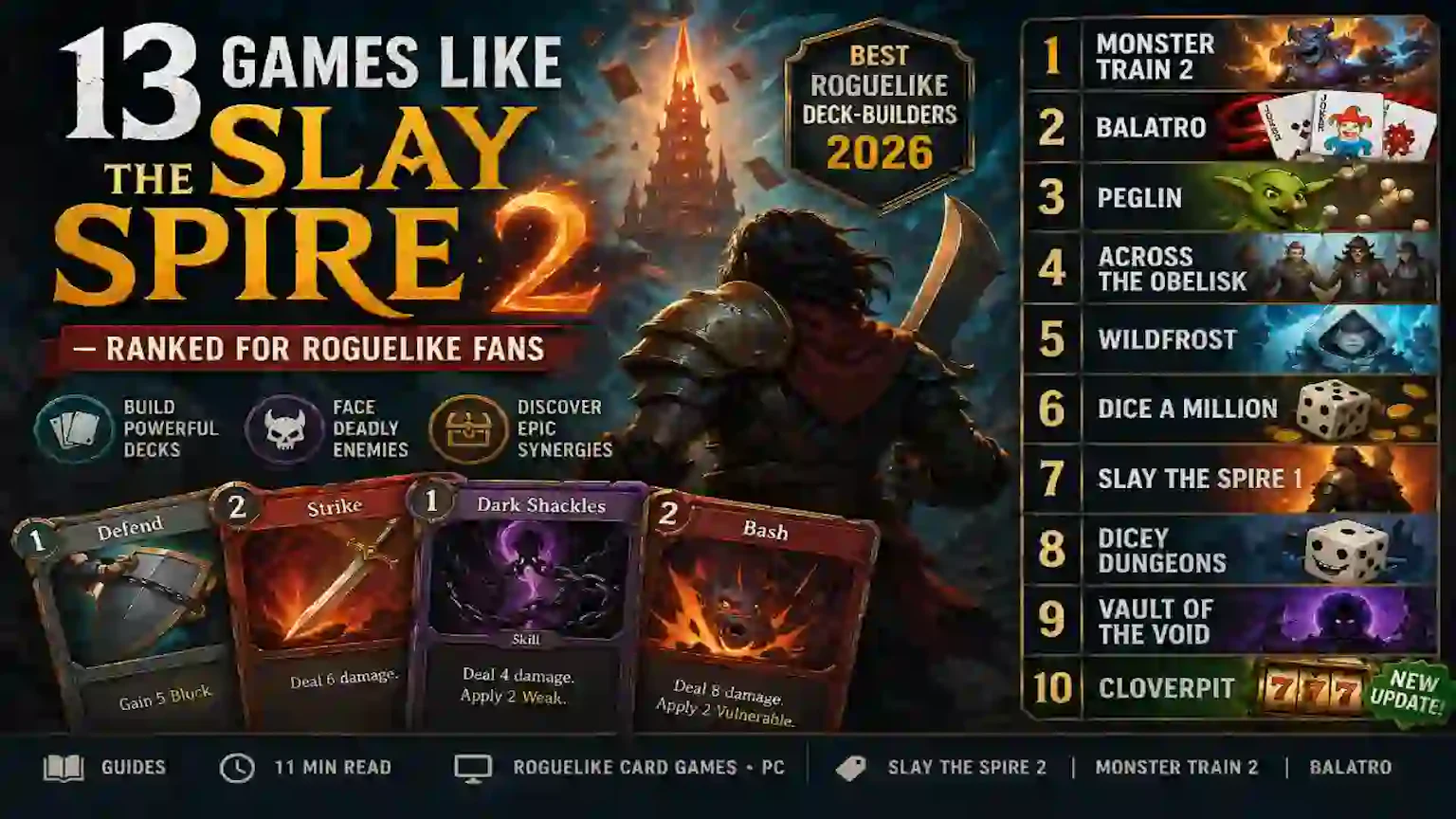
10 Best Games Like Slay the Spire 2 (2026) — Ranked for Roguelike Fans
If you've burned through your early access runs and need something to fill the gap, here's where to go next.
Slay the Spire 2 hit Steam Early Access on March 5, 2026, and within days it had already taken over every gaming Discord, subreddit, and "what are you playing" thread on the internet. Mega Crit basically invented a genre with the first game — and the sequel doubled down on everything that made it great. New characters, alternate acts that completely change each run, 4-player co-op, 575+ cards, and an Enchantment system that adds another layer of build insanity on top of an already deep foundation.
But here's the thing about Early Access. The content runs out eventually. You beat a run with the Necrobinder. You try a few different archetypes. You hit the current content wall and stare blankly at the main menu.
So what do you play next?
These are the 10 best games like Slay the Spire 2 right now — picked specifically because they scratch the same itch: tight card synergies, run-based progression, decisions that actually matter, and that one-more-run pull that keeps you up until 2am.
What Makes a Good "Games Like Slay the Spire 2" Pick?
Before diving into the list, it's worth knowing what we're actually looking for. Not every roguelike qualifies. The specific appeal of Slay the Spire 2 comes down to a few things:
- •Deck-building as the core loop — not just a side mechanic
- •Run-based structure — you die, you start over, you bring new knowledge
- •Synergy hunting — that eureka moment when two cards combine into something broken
- •Relic/passive system — permanent modifiers that reshape every run
- •High replayability — no two runs feel the same
Keep those in mind as you browse this list. Every game here delivers on most or all of them.
1. Monster Train 2 — The Closest Thing to a Rival
Platforms: PC, PS5, Xbox Series X|S, Switch | Released: May 21, 2025
If Slay the Spire 2 is the king of the genre right now, Monster Train 2 is the pretender to the throne — and a genuinely excellent one. The sequel to the already-stellar Monster Train picks up the premise of the original: you're defending a moving train through Hell, stopping waves of enemies from reaching and destroying the Pyre at the top.
What separates Monster Train from most Slay the Spire alternatives is the vertical lane combat. Enemies work their way up three train floors to reach your Pyre, and you're placing units on each level to block them. It's not just a card game — it's a card game with light tower defense logic baked in. That added layer of spatial thinking makes your decisions feel different from anything StS offers.
The clan fusion system is where the real magic lives. You pick two clans at the start of a run and build a deck around their synergies. The combinations are wild — some of them are intentionally silly, others are borderline broken. Either way, you're always discovering something new.
Play this if: You want something mechanically close to Slay the Spire 2 but with more moving parts.
2. Balatro — The One That Broke Everyone's Brain
Platforms: PC, PS4/5, Xbox, Switch, Mobile | Released: February 2024
Balatro doesn't look like it belongs on this list. It's a poker game. Kind of. Actually, it's a roguelike deckbuilder that uses poker hands as its combat system, and once you understand what it's doing, you will not put it down for days.
You build a deck of playing cards, play poker hands to score points, and buy Jokers between rounds that modify, amplify, and occasionally completely break how scoring works. Hit certain thresholds and you advance. Miss them and the run ends. Simple on the surface. Absurdly deep underneath.
The synergy hunting in Balatro hits the same dopamine centers as Slay the Spire 2. Finding a Joker that multiplies your score each time you play a pair, then building your entire deck around pairs, then adding another Joker that doubles multiplier Jokers... yeah. You see where this goes. It's the same "broken build" feeling, just with playing cards instead of fantasy spells.
Play this if: You love the math and synergy side of Slay the Spire 2 more than the combat fantasy.
3. Inscryption — The Weird One (Play It Blind)
Platforms: PC, PS4/5, Xbox, Switch | Released: October 2021
Do not look this one up before playing it. Seriously. Go in knowing only this: it's a deck-building roguelike where you play cards across a dark table against a creature lurking in the shadows, and it gets increasingly strange.
On the surface it's a fairly traditional card battler — creatures attack, you block, you manage resources, you build synergies. The card mechanics are clever and satisfying in their own right. But Inscryption does something that very few games in this genre attempt: it wraps all of it inside a mystery that unfolds in a genuinely unsettling way.
It's darker, weirder, and shorter than Slay the Spire 2. But it's also one of the most memorable games in the genre precisely because it uses the structure of a roguelike deckbuilder to tell a story you'll be thinking about for days after.
Play this if: You want the genre to genuinely surprise you.
4. Griftlands — Fight AND Talk Your Way Through
Platforms: PC, PS4, Xbox One, Switch | Released: June 2021
Most deck-builders give you one deck. Griftlands, from Klei Entertainment (the same studio behind Don't Starve and Oxygen Not Included), gives you two — and here's the twist. One is your combat deck. The other is your negotiation deck.
Set in a grungy sci-fi world called Havaria, Griftlands has you navigating a world of factions, rogues, and shifting alliances. Sometimes you fight. Sometimes you talk. And both are resolved through card battles. Your negotiation deck works just like your combat deck — you play cards, manage resources, hit thresholds — but instead of dealing damage, you're making arguments, applying pressure, and breaking your opponent's resolve.
It's a genuinely clever idea that makes every run feel like you're actually living in a world rather than just grinding through rooms. The narrative choices matter too — who you side with and who you cross changes what cards and options are available to you later.
Play this if: You want a deeper story layer wrapped around your deck-building.
5. Peglin — Slay the Spire Meets Peggle, Somehow
Platforms: PC, Switch | Released: April 2022
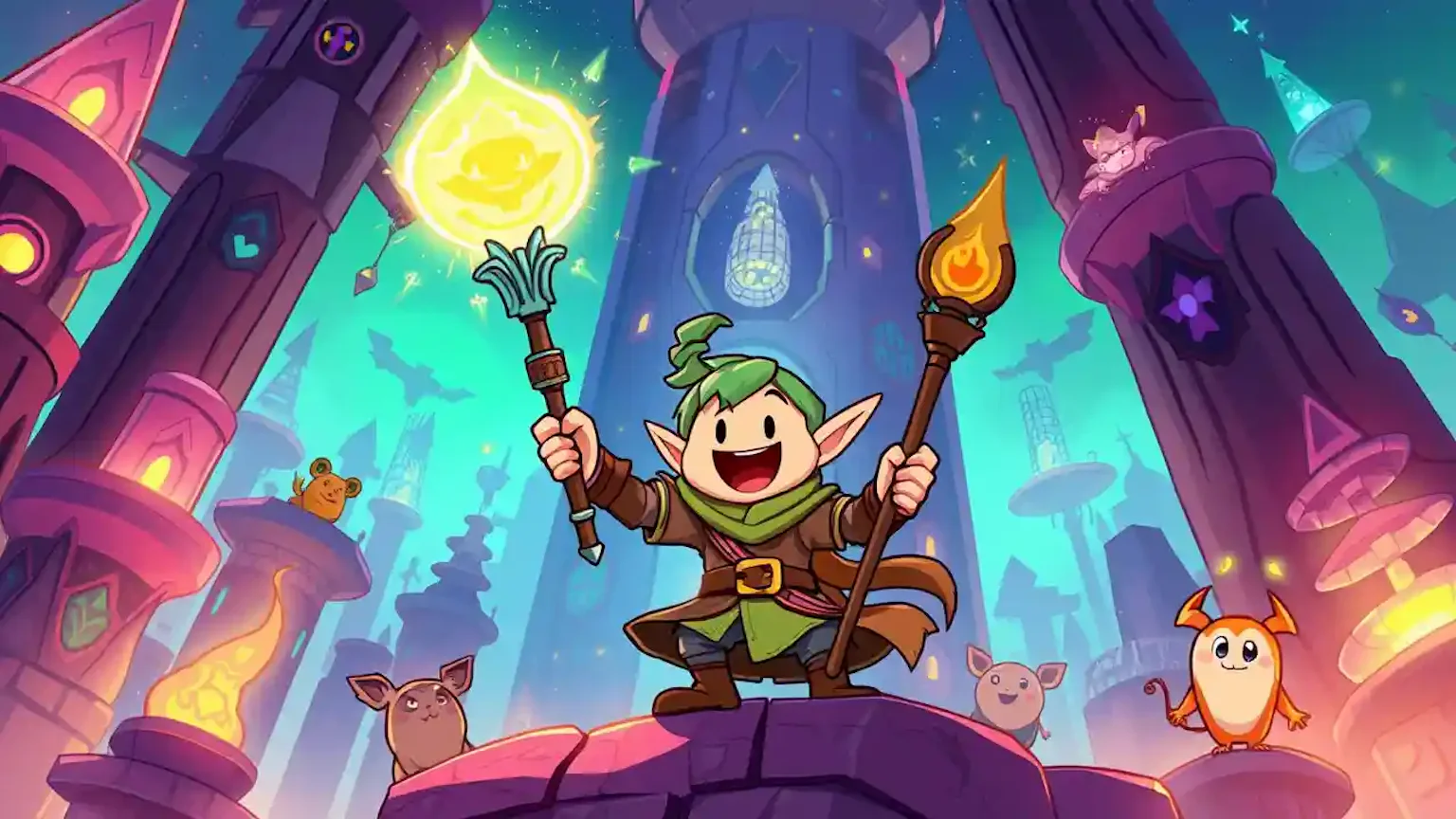
The Steam page for Peglin literally describes it as "Peggle meets Slay the Spire" and that's not even a stretch. You're a goblin. You launch marbles into peg boards to deal damage to enemies. As you progress, you collect new orbs (your "cards"), relics that modify how they behave, and encounter increasingly dangerous rooms on your way to whatever boss lies ahead.
The Peggle element adds something most deck-builders don't have: genuine physical skill. You need to aim. A well-placed shot can chain across a dozen pegs and wipe out an entire health bar. A badly placed one does almost nothing. That mix of planning and execution makes Peglin feel distinctly different from StS while scratching the exact same itch.
It's also just charming as hell. The goblin is adorable, the enemy designs are goofy and fun, and the whole thing has an energy that's hard not to enjoy.
Play this if: You want the run structure and synergy loop of Slay the Spire 2 with a physical skill element added.
6. Across the Obelisk — Built for Co-Op Fans
Platforms: PC, PS5, Xbox Series X|S, Switch | Released: 2021**
Slay the Spire 2's new 4-player co-op mode is one of its most-talked-about additions. If that feature is what drew you in, Across the Obelisk is where you need to go — because co-op is literally the point of this game.
Up to four players each control a hero with their own deck, and you coordinate your builds to complement each other through a branching fantasy world full of events, battles, and decisions that permanently affect your run. Tank, healer, damage dealer, debuffer — the classic RPG roles are all here, and syncing your decks with your friends is the entire appeal.
Solo play is viable but noticeably less interesting. This one's made for a group. If you've got people to play with, it delivers something that almost nothing else in the genre offers.
Play this if: The co-op in Slay the Spire 2 is your favorite feature.
7. Roguebook — Two Heroes, One Deck Problem
Platforms: PC, PS4/5, Xbox, Switch | Released: June 2021
Roguebook comes from the creators of the Faeria card game, and it shows. This is a more mechanically polished, almost elegant take on the roguelike deckbuilder compared to something like Griftlands' gritty chaos.
You always control two heroes simultaneously, and the key strategic wrinkle is positioning. One hero sits at the front, one at the back, and their abilities interact differently based on where they are. Swapping them mid-combat to trigger certain effects is a constant micro-decision that adds a satisfying layer of depth.
Visually it's gorgeous too — bright, colorful, clearly inspired by classic fantasy card art. If Slay the Spire 2's darker aesthetic isn't your thing, Roguebook offers the same mechanical depth in a much more cheerful package.
Play this if: You like the two-character dynamic and want something visually distinct.
8. Wildfrost — Cold, Beautiful, and Punishing
Platforms: PC, Switch | Released: April 2023
Wildfrost is one of the most underrated games in the genre. It's a roguelike deckbuilder set in a frozen world perpetually under an endless winter — you're building a team of companions and items to push back the cold and reach the Sun Temple. It's lovely.
It's also significantly harder than most of its peers. Wildfrost uses a turn-countdown system where every card, companion, and enemy has a counter that ticks down, and things happen when that counter hits zero rather than on a strict "your turn, my turn" basis. This makes timing everything. Staggering your attacks to hit before enemies can fire back. Chaining freezes and counters to control the board. It's the most genuinely strategic combat system on this list.
Fair warning: the early hours are brutal. The game doesn't explain itself well, and you'll probably lose your first five or six runs before the mechanics click. But when they do? It's exceptional.
Play this if: You want the hardest, most tactical option on this list.
9. Dice A Million — If Numbers Going Up Is Your Thing
Platforms: PC | Released: February 2026
Fresh out of 2026, Dice A Million is the newest entry on this list and one of the most oddly addictive. The mission statement is absurd and literal: roll dice, score a million points. That's it. That's the game.
In practice it's a roguelike where you build a pool of dice with unique effects — some multiply scores, some trigger chain reactions, some literally set things on fire — and equip rings to your character that modify how those dice behave. The score escalation gets genuinely ridiculous in the late game, numbers cascading into each other in ways that feel chaotic but are actually deeply strategic when you understand the underlying systems.
It's the most minimal game on this list in terms of presentation. No narrative, no world-building, just numbers and dice. But if the pure mechanical loop of Slay the Spire 2 is what you love most, this scratches it in a surprisingly pure way.
Play this if: You're a numbers person who wants pure mechanical satisfaction.
10. The Original Slay the Spire — Still Great in 2026
Platforms: PC, PS4, Xbox, Switch, iOS | Released: 2019**
Yeah, the obvious one. But it belongs here. The original Slay the Spire is still one of the best deck-building roguelikes ever made, and if you came to the sequel first, going back to the original is a genuinely worthwhile experience. Four characters — the Ironclad, the Silent, the Defect, and the Watcher — each with completely different playstyles that barely overlap. The Ironclad is your bruiser, leaning into strength scaling and heavy armor. The Silent is a poison and shiv specialist who wins through a thousand small cuts. The Defect plays like nothing else in the genre, generating Orbs that passively deal damage or generate energy depending on how you manage them. And the Watcher — unlocked last — is arguably the most broken character in the game if you know what you're doing, built around a Stance system that can double your damage output when timed right. Thousands of viable build combinations across all four. A difficulty ladder through Ascension levels that gives hardcore players something to chase for literal years. And a shorter, tighter structure than the sequel that's arguably better for quick sessions when you don't have two hours to commit to a full run. The sequel has more of everything — more cards, more characters, more content, more systems. But the original has a purity to it. Less clutter, more focus. Some players who sank 500 hours into the first game genuinely prefer it to the sequel, and they're not wrong to. Play this if: You want to see where it all started — or you just want more StS and somehow haven't played the first one yet.
11. Dicey Dungeons — Quick, Clever, Endlessly Replayable
Platforms: PC, Switch, Mobile | Released: 2019
Dicey Dungeons doesn't get talked about enough. Made by Terry Cavanagh — the same developer behind the punishing platformer VVVVVV — it's a roguelike where you roll dice and slot them into equipment cards to deal damage, apply effects, and survive increasingly dangerous floors.
The concept sounds simple. It isn't. Each of the six playable characters plays by genuinely different rules. The Robot can reboot and change the entire way dice work mid-run. The Witch draws spells and curses herself. The Jester gets wildcard rules that change every episode. Playing every character feels like a different game built on the same foundation.
It's shorter and lighter than Slay the Spire 2 — a full run takes maybe an hour — which actually makes it perfect for filling gaps between longer sessions. Low stakes, high fun. One of those games where you tell yourself "just one more run" and suddenly it's midnight.
Play this if: You want something breezy and fast that still has serious mechanical depth underneath.
12. Vault of the Void — For the Hardcore Theorycrafters
Platforms: PC | Released: 2022
This one is not for everyone. Vault of the Void is arguably the most mechanically demanding deck-builder on this entire list — and that's a high bar given Wildfrost is also here.
The biggest difference from Slay the Spire 2 is the purging system. You start every run with a massive pool of cards and spend the entire run trimming it down. Instead of adding cards to build your deck, you're removing the bad ones to sharpen your deck into something lethal. It completely flips the usual deck-building logic on its head.
There's also a deep preparation phase before each fight where you manually arrange your hand and plan your opening moves. No randomness at the start of combat — you see your hand, you see the enemy's intent, and you set up accordingly. It rewards planning over luck in a way most games in the genre don't.
If you're the kind of player who spent hours optimizing runs in Slay the Spire 2 and still felt like there could be more control, Vault of the Void is basically built for you specifically.
Play this if: You want the deepest, most theorycraft-heavy deck-builder in the genre.
13. CloverPit — The Slot Machine You Can't Stop Pulling
Platforms: PC | Released: 2025 — Unholy Fusion DLC just dropped April 2026
CloverPit is a bit of an odd one but it belongs here. It's a roguelike built around slot machine mechanics — you spin, symbols align, effects trigger, damage happens. But underneath the spinning reels is a genuinely deep build system where you're crafting charm fusions, stacking synergies between symbols, and making strategic decisions every single run.
The recently dropped Unholy Fusion DLC added 30 new charm fusions and shadow-dropped just this week, making it a perfect time to jump in. The community around it has exploded in the last few months, and once you understand how the symbol interactions work, the "one more spin" pull is basically impossible to resist.
It scratches a slightly different itch than Slay the Spire 2 — less tactical, more chaotic — but the underlying DNA of roguelike progression and synergy-hunting is all there.
Play this if: You want something faster and more anarchic with a surprising amount of strategic depth.
Quick Reference — Which Should You Play First?
You want... - Play this
The closest to StS 2 - Monster Train 2
Pure synergy math - Balatro
Something genuinely weird - Inscryption
A story that matters - Griftlands
Co-op deck-building - Across the Obelisk
Maximum challenge - Wildfrost
Hardcore theorycrafting - Vault of the Void
Pure mechanics, no fluff - Dice A Million
Fast, breezy sessions - Dicey Dungeons
Chaotic slot machine roguelike - CloverPit
A charming, weird twist - Peglin
Two-hero strategy - Roguebook
More of the exact same thing - Slay the Spire 1
The Bottom Line
Slay the Spire 2 set the bar absurdly high. But the good news is the roguelike deck-builder genre spent the last several years building up to meet it — and there are more genuinely brilliant games in this space right now than at any point in history.
If you're only picking one, start with Monster Train 2. It's the most direct translation of everything StS 2 does well into a slightly different format, polished to a mirror shine.
After that? Balatro will make you question every assumption you had about what a card game can be. Inscryption will genuinely surprise you. And Vault of the Void will consume every free hour you have for the next two weeks.
The spire may be dormant between updates. The genre definitely isn't.